
7 Mistakes You’re Making with Car Suspension Repair (and How to Fix Them)
Have you ever driven down a bumpy road in Cambridge and felt like your car was a pogo stick? Or maybe you’ve noticed that your steering feels a bit “mushy” lately. When your car starts handling like a shopping cart with a bad wheel, your first instinct might be to hop under the hood: or the wheel well: and try to fix it yourself.
We love a good DIY spirit here at Preston Auto Services, but the suspension system is one of the most complex parts of your vehicle. It’s not just about comfort; it’s about keeping your tires on the road and ensuring you can steer out of harm’s way.
Unfortunately, many well-intentioned drivers (and even some amateur shops) make critical errors during a car suspension repair. These mistakes can lead to more expensive fixes down the road or, worse, a dangerous situation on the 401.
Let’s dive into the seven most common mistakes you might be making with your suspension and, more importantly, how you can fix them to keep your ride smooth and safe.
1. Replacing Only One Shock or Strut
It’s a classic scenario: you hit a massive pothole, and now your front-right strut is leaking. To save a few bucks, you buy one replacement part and swap it out. Job done, right? Not exactly.
Suspension components work in harmony. If you have one brand-new, stiff shock and one old, tired shock on the same axle, your car’s balance will be completely thrown off. This leads to uneven tire wear, wonky braking, and unpredictable handling during emergency maneuvers.
The Fix: Always replace suspension components in pairs. If the front-left goes, the front-right needs to go too. This ensures your car stays level and responds symmetrically when you turn the wheel. If you’re unsure if yours are shot, check out these top signs your car needs immediate auto repair.

2. Skipping the Wheel Alignment
This is perhaps the most common mistake in the book. You spend the weekend successfully installing new control arms or struts, and the car feels “fine” on the test drive, so you skip the trip to the shop.
Here’s the reality: almost any work done on your suspension will slightly change the angle at which your tires meet the road. Even a fraction of a degree of “toe” or “camber” misalignment can scrub the tread off your expensive tires in just a few hundred kilometers.
The Fix: Every time you touch a suspension component, you need a professional wheel alignment. It’s the final step that ensures your hard work doesn’t go to waste. You can learn more about why wheel alignment matters to see how it protects your performance.
3. Lifting Too High (The “Geometry” Trap)
We get it: a lifted truck or SUV looks amazing. But if you’re using a cheap lift kit or just cranking up the torsion bars to get that aggressive stance, you’re likely pushing your suspension geometry past its breaking point.
When you lift a vehicle excessively without correcting the angles of the CV axles and control arms, you put immense stress on the joints. This leads to premature failure of your ball joints and can even cause your axles to pop out.
The Fix: If you’re going for a lift, do it right. Use a high-quality kit that includes drop brackets or longer control arms to keep the geometry as close to factory specs as possible. Better yet, consult a mechanic near me who specializes in suspension repair in Cambridge to make sure your mods aren’t a safety hazard.

4. Mixing and Matching Different Brands
If you’re a bargain hunter, you might find a deal on one brand of springs and another brand of shocks. While they might physically fit together, they weren’t engineered to work as a team.
Manufacturers design suspension kits so the “spring rate” (how stiff the spring is) matches the “valving” of the shock (how it dampens the bounce). If they aren’t matched, you might end up with a ride that is teeth-chattering stiff or dangerously bouncy.
The Fix: Stick to a single manufacturer for your core components. If you’re upgrading, look for a “tuned” kit where the shocks and springs were tested together. This ensures a predictable, comfortable ride that actually improves your car’s handling.
5. Tightening Bolts While the Car is Jacked Up
This is a technical mistake that many DIYers make. When you install a new bushing or control arm, it’s tempting to tighten everything down while the car is still up on jack stands.
However, suspension bushings are designed to be tightened at “ride height”: meaning when the full weight of the car is on its wheels. If you tighten them while the suspension is hanging down, the rubber bushings will be under constant “twist” once you lower the car. This will cause them to tear and fail within weeks.
The Fix: Finger-tighten your bolts while the car is in the air. Once the car is back on the ground (or on ramps), crawl under and perform the final torque to spec. This allows the bushings to sit in their neutral position, greatly extending their lifespan.

6. Ignoring the “Support Cast” (Bushings and Mounts)
When people think of car suspension repair, they usually think of the big stuff: the shocks, the struts, and the springs. But the suspension system is held together by a “support cast” of rubber bushings, ball joints, and strut mounts.
If you put a brand-new strut onto a worn-out, cracked strut mount, you’re going to keep hearing that annoying “clunk” every time you hit a bump. It’s like putting a high-performance engine in a car with a broken transmission: you’re not getting the full benefit.
The Fix: Inspect everything while you’re in there. If you’re taking the time to remove a strut, spend the extra $30 to replace the strut mount and the rubber bump stops. It saves you from having to do the whole job twice. If you aren’t sure what’s making that noise, our auto diagnostics can pinpoint the exact culprit.
7. Overloading Your Vehicle Regularly
This isn’t exactly a “repair” mistake, but it’s a “usage” mistake that leads to repairs. Every vehicle has a Gross Vehicle Weight Rating (GVWR). If you’re constantly hauling heavy loads of lumber or towing a trailer that’s too heavy for your crossover, you are crushing your springs and overheating your shocks.
Overloading causes the suspension to “bottom out,” which can bend components and destroy the internal seals of your dampers.
The Fix: Know your vehicle’s limits. If you consistently carry heavy loads, consider upgrading to heavy-duty springs or an air-leveling system. And remember, if you’ve been hauling heavy for years, your suspension might need a refresh sooner than the owner’s manual suggests.

DIY vs. Professional Repair: Which is Right for You?
We’ve seen plenty of successful DIY suspension jobs, but we’ve also seen cars towed into our shop in pieces because a “simple” bolt got snapped or a coil spring compressor slipped (which is incredibly dangerous, by the way).
Suspension work often requires specialized tools like:
- Hydraulic presses for bushings.
- Heavy-duty coil spring compressors.
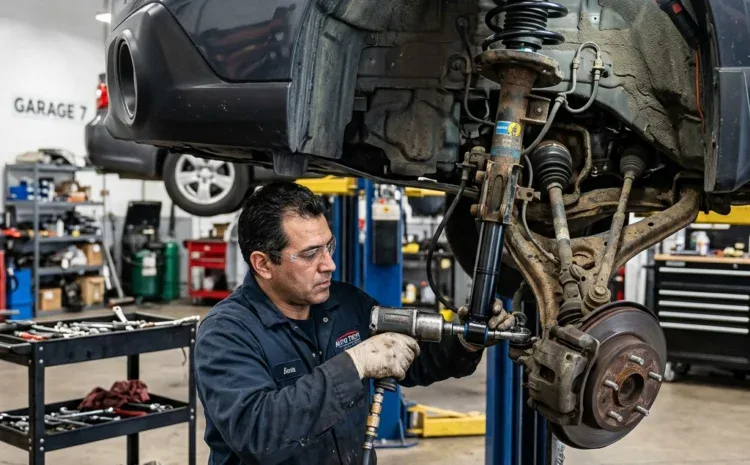
- Pneumatic impact wrenches for rusted bolts.
- Precision alignment racks.
If you’re working on a modern car: say, something from the 2015–2019 era: the suspension is often integrated with electronic stability control and steering angle sensors. Messing up a mechanical repair can throw a “service ESC” light on your dash, requiring specialized auto engine repair or computer recalibration.
Why Choose Preston Auto Services in Cambridge?
At Preston Auto Services, we live and breathe automotive care. We understand that your car is more than just a way to get from A to B; it’s what keeps your family safe on the road. When you bring your car to us for car suspension repair, you’re getting:
- Local Expertise: We know the Cambridge roads and how the salt and potholes affect your undercarriage.
- Precision Equipment: Our alignment and diagnostic tools are top-of-the-line, ensuring the job is done right the first time.
- A Friendly Team: We don’t talk down to you. We explain what’s wrong, why it needs fixing, and what your options are.
Don’t let a small “clunk” turn into a major safety issue. Whether you need a quick inspection or a total suspension overhaul, we’re here to help.
Ready to get that smooth ride back? Book an appointment today, and let’s get your car handling like new again!